Most business owners assume America is out of reach.
Not because they doubt their product. Not because they think they can’t compete. But because somewhere along the way they picked up an idea that going to the US means one of two things — a lottery visa you probably won’t win, or an investment visa that needs crores of rupees parked in someone else’s project.
Neither of those is the route business owners actually use.
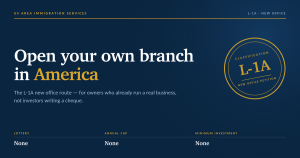
The route business owners use is called the L-1A new office — and it is built on a very simple idea: if you already run a real business, you can open a branch of that business in the United States, and go run it yourself.
That’s it. That’s the whole concept.
What “new office” actually means
Let’s take the jargon out of it.
You have a company. It trades, it has staff, it makes money. What you want is a second company in America — a branch, a subsidiary, an extension of what you already do — so you can sell directly into the US market instead of through agents, distributors, or a laptop screen six time zones away.
That American company doesn’t exist yet. You’re opening it fresh. That’s what “new office” means.
The L-1A lets you move yourself across to run it. You’re not applying as an employee looking for a job. You’re not applying as an investor putting money into a project. You’re applying as the owner of a business, transferring into your own new branch.
This is why it’s called a business visa and not an investment visa. What qualifies you is the business you built — not the size of the cheque you’re prepared to write.
Why business owners choose this route
There’s no lottery and no annual cap
The H-1B has a lottery. Every year thousands of people submit, most don’t get picked, and there’s nothing you can do about it. The L-1A has no lottery and no annual quota. You file when your business is ready. That’s a fundamentally different relationship with the process — you’re in control of the timeline, not a random draw.
There’s no fixed investment requirement
This is the one that surprises people most.
Visas like the E-2 and EB-5 are built around money. There’s a number, and you have to meet it. The L-1A has no mandated minimum investment. None.
You do need enough capital to actually set up and run the US branch sensibly — office, staff, operating costs for the first stretch. But there’s no threshold you have to hit, and nobody is asking you to hand funds to a third party. The money you spend goes into your own business, and you keep it.
You keep your business back home
You are not closing anything down. In fact, your existing company must stay operational — it’s the anchor of the whole arrangement. Most owners appoint a trusted manager to handle day-to-day operations at home while they build the US side, and continue overseeing both.
Your family comes with you
Your spouse gets a dependent visa and can apply for work authorisation — meaning they can work for any US employer, or run something of their own. Your children go to US schools.
There’s a road to a green card at the end of it
A new office L-1A is typically granted for one year to start, then extended — up to seven years in total. But that’s not the end of the story. After roughly a year of genuinely operating your US business, the EB-1C category opens up: permanent residency for multinational managers and executives, and notably without the labour certification step that slows down most employment-based green cards.
So the L-1A isn’t just a work permit. For a lot of owners, it’s the first step of a much longer plan.
What the US market actually offers you
It’s worth being blunt about why this is worth the effort.
The US is a $27 trillion economy — larger than the next three countries combined. 332 million people, with among the highest average spending power in the world. And for many business owners, a ready-made first customer base: large, high-income diaspora communities who already know your product, your food, your brand.
But the real argument isn’t market size. It’s margin.
Think about how you sell to America right now. If you export, there’s probably an agent or an importer between you and the buyer, taking their cut. If you provide services, you’re quoting remote rates — and losing enterprise contracts to competitors who have a US address on their proposal.
A US branch changes that equation:
- Exporters deal directly with retailers, brands and buyers instead of losing 20–30% to middlemen
- Service companies win contracts that require a local presence and command local rates
- Manufacturers sell direct to distributors, manage quality issues on the ground, and become the “local” option in an era where American buyers are actively looking to diversify supply chains
- Food businesses get past the distribution wall and onto real shelves
The same product. The same team. A completely different price you can charge for it.
This is not just for IT companies
There’s a persistent assumption that US expansion is a tech thing. Software companies, IT services, maybe pharma. Everyone else stays home.
That’s simply not how the L-1A works. It doesn’t care what industry you’re in. It cares whether you run a genuine business.
Business owners using this route include:
- Manufacturers — auto parts, machine tools, castings and forgings, electrical equipment
- Textile and garment businesses — readymade garments, home textiles, fabrics
- Exporters of all kinds — spices, rice, ready-to-eat foods, organic products
- Restaurants and food businesses — where the diaspora market and mainstream American appetite for global cuisine have created real, provable demand
- Pharma and healthcare — generics, APIs, medical devices, traditional medicine
- Gems, jewellery and handicrafts — an industry where craftsmanship is the selling point and being present at US trade shows changes everything
- Construction, interiors and architecture firms — bidding on American commercial projects
- Education and training companies — selling into US schools and corporate clients
- Engineering and consulting practices — CAD/CAM, structural, environmental, R&D
- IT and software — yes, this too, but it’s one category on a long list
If you make something, sell something, or provide a service that Americans want, you’re in scope. The question is never “is my industry allowed?” — it’s “is my business real, and is there demand over there?”
And it’s not just for large companies
The other assumption worth demolishing: that you need to be a big corporate house.
You don’t. This route is built for small and mid-sized businesses — the kind with a few dozen people on payroll, steady revenue, an owner who knows every customer by name. In practice, businesses with around 10 or more employees and healthy annual revenue tend to present well. Some are considerably smaller than that.
What matters isn’t headcount. It’s substance:
- The business has been trading for a couple of years
- There are real employees on real payroll — not a one-person operation
- It’s profitable, and the financial statements show it
- You genuinely run it — you’re the decision-maker, not a figurehead
A 30-person spice export company with steady margins is a stronger candidate than a flashy startup with no revenue. This route rewards operators.
It also doesn’t matter where you’re based. Owners come from major metros and from Tier-2 and Tier-3 cities alike — Ludhiana, Coimbatore, Rajkot, Surat, Nagpur. The strength of your business is what counts, not the size of your city.
How the journey actually works
Four stages, start to finish.
- Business assessment. Before anything else, your existing business is checked against what the process requires — company history, revenue, employees, your role, and whether there’s genuine US demand for what you sell. This takes a few days and tells you whether it’s worth proceeding, before you spend on anything.
- Setting up the US company. The American entity gets registered, a tax ID obtained, a business bank account opened, and — importantly — real physical office space secured. All of this can be handled remotely; you don’t need to be in the US to make it happen.
- Business plan and filing. A proper plan is prepared covering your US market opportunity, financial projections, hiring plan and your role running the operation. It’s filed with the complete petition. With premium processing, a decision typically comes back within about 15 days rather than several months.
- Launch. Approval, visa stamping, arrival, first hires, first clients. And from month one, building the track record that supports your extension — and your green card case later.
The honest version
The L-1A isn’t a shortcut and it isn’t a guarantee. Petitions do get refused, usually for predictable reasons — the owner’s role reads like a one-person operation, the corporate link between the two companies is asserted rather than properly documented, or the business plan makes claims nobody would believe.
Every one of those is a problem you can fix before filing, which is exactly why the assessment stage matters more than anything else in the process.
But if you’re sitting on a business that works — real customers, real staff, real profit — and you’ve been quietly wondering whether America is possible, the answer is more likely yes than you think.
The businesses making this move aren’t extraordinary. They’re just well-run.
Find out where you stand
USAIS handles the whole journey end to end — assessment, US company formation, office space, business plan, petition filing, and support after approval. We have 16 physical offices in the United States and 30+ offices across India, with over 50 years of combined immigration experience behind the team.
The first conversation is free, and it’s an honest assessment — not a sales pitch.
Phone: +91 9056794311
Email: info@usareaimmigrationservices.com
Office: US HQ: 39159 Paseo Padre Pkwy, Ste 115, Fremont, CA 94538
Book your free business assessment →
Immigration disclosure: This article is general information about L-1A visa services and is not legal advice. Immigration outcomes are determined solely by USCIS and depend on individual circumstances. Processing times, fees and policies are subject to change. Past results do not guarantee future outcomes.