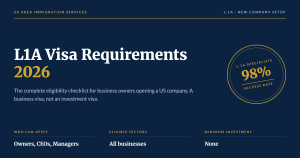
The L1A visa lets a business owner, manager or executive transfer from their company abroad to a related company in the United States, including a brand-new US office they set up themselves. There is no lottery, no annual cap and no minimum investment. But the L1A visa requirements are strict, and a well-prepared petition makes all the difference.
This guide explains every L1A requirement in plain language, lists the documents you need, and shows the most common reasons petitions get an RFE or are denied, so you can file a complete case the first time.
Quick answer: To qualify for an L1A visa, you need (1) a qualifying relationship between your foreign company and the US company, (2) at least one continuous year of work for the foreign company in the last three years, (3) a managerial or executive role, both abroad and in the US, and (4) both companies actively doing business. For a new US office, you also need a secured physical office and a credible one-year business plan.
In this guide:
- L1A is a business visa, not an investment visa
- L1 visa eligibility: who can apply for L1A new company setup
- L1 visa requirements: the 4 core rules
- Extra L1A requirements for a new US office
- L1 visa documents checklist
- L1 visa RFE and rejection reasons
- L1 visa processing time in 2026
- Frequently asked questions
L1A in numbers
| USCIS FY2025 data (L-1A) | Figure |
|---|---|
| Petitions completed | 24,539 |
| Approved | 22,535 (about 92%) |
| Received an RFE | about 24%, roughly 1 in 4 |
| Approved after an RFE | about 71% of those |
Source: USCIS data for FY2025, as reported by immigration analysts. About one in four L1A cases receives an RFE, which delays the decision. A complete petition from day one saves time and stress.
L1A is a business visa, not an investment visa
The L1A is often confused with investor visas like the EB-5. It is not an investment visa. You don’t buy your way in with a fixed investment amount. The L1A is a business expansion visa: your existing, operating company opens a new office in the USA, and you move there to set it up and manage it.
You do need enough funding to run the US office properly (a lease, salaries and first-year costs), sized to your business plan. But there is no minimum investment set by law, and the money goes into your own US company, not into someone else’s project.
L1 visa eligibility: who can apply for L1A new company setup?
Our eligibility checklist for business owners
The law sets the core rules (explained in the next section). Based on what USCIS scrutinises in new office cases, these are the standards we look for before taking on a new company setup, because they make a petition far stronger:
- ☐ Operating for at least 2 years: your foreign company has been actively trading for a minimum of 2 years.
- ☐ 3 or more employees on payroll: a genuine business with an active workforce, not a one-person operation. This also shows you already manage a team.
- ☐ Profitable and financially stable: the business is profitable, with a healthy financial track record that can support a new US operation.
- ☐ At least 1 year in a managerial or executive role in that company within the last 3 years.
Who can apply: eligible roles
Any genuine managerial or executive role can qualify, including:
| Owners and top leadership | Senior and functional managers |
|---|---|
| Business owner | Senior manager |
| Director | General manager |
| CEO | Operations manager |
| President | Functional manager (heading a key function such as finance, sales or technology) |
What counts is the role you actually perform: you direct people, a department or a key function, and make real decisions. A title alone is not enough.
Eligible business categories: all sectors welcome
Any legitimate, operating business can expand to the USA through the L1A. Sectors we commonly work with include:
| IT & Software Services | Import / Export & Trading | Jewellery Stores & Manufacturing |
| Consulting & Advisory | Manufacturing & Industrial | Textiles, Garments & Apparel |
| Healthcare & Pharmaceuticals | Food & Beverage / FMCG | Real Estate & Construction |
| Logistics & Supply Chain | Education / EdTech | E-commerce & Retail |
| Hospitality & Travel | Financial Services / FinTech | Any other legitimate business |
L1 visa requirements: the 4 core rules
Every L1A petition, whether for an existing US company or a new office, must prove these four things.
1. A qualifying relationship between the two companies
Your company abroad and the US company must be part of the same group. USCIS accepts four types of relationship:
| Relationship | What it means | Example |
|---|---|---|
| Parent | The foreign company owns and controls the US company | Your Indian company owns a US company |
| Subsidiary | The US company is owned more than 50%, or 50% with equal control | Softedge Infotech Pvt Ltd owns Softedge Infotech Inc. |
| Branch | An office of the same company in another location, not a separate legal entity | Your Indian company opens a US branch office |
| Affiliate | Both companies are owned and controlled by the same person or group | You personally own both the Indian and the US company |
Prove it with: share certificates, incorporation documents, shareholder registers, and an ownership chart showing exactly who owns what.
2. One continuous year abroad in the last three years
You must have worked for the foreign company full time for at least one continuous year within the three years before the petition is filed. Short business trips to the US don’t break this year, but time spent living and working in the US doesn’t count towards it.
Prove it with: appointment letter, salary slips, bank statements showing salary credits, Form 16 or income tax returns, and director records.
3. A managerial or executive role
This is the requirement USCIS looks at most closely. The L1A is only for people who manage, not people who do the day-to-day work.
- Manager: manages the organisation, a department or an essential function; supervises other managers or professionals (or manages a key function); can hire, fire or recommend personnel actions; and has discretion over daily operations.
- Executive: directs the management of the organisation or a major part of it, sets goals and policies, has wide decision-making authority, and reports only to top executives, the board or shareholders.
You must hold such a role both abroad and in the US. Job titles don’t count on their own. USCIS looks at what you actually do every day and who reports to you.
Prove it with: organisation charts for both companies showing your position and your reports, a detailed job description with a percentage breakdown of your time, and evidence of your decisions (contracts signed, hiring records, budgets approved).
4. Both companies are actively doing business
Both companies must be doing regular, systematic and continuous business, providing real goods or services. Simply having an agent or a registered office is not enough. The foreign company must also keep operating while you are in the US.
Prove it with: recent invoices, client contracts, GST returns, audited financial statements, and bank statements for the Indian company.
Extra L1A requirements for a new US office
If your US company has been doing business for less than one year, your petition is a new office petition. Because there is no US track record yet, USCIS judges the case on what the office will become. The rules (8 CFR 214.2(l)(3)(v)) add three more requirements:
1. A secured physical office
You must have sufficient physical premises for the US office before you file. In practice, that means a signed commercial lease (or purchase deed) for space that fits your business plan.
- Usually accepted: a dedicated office with a signed lease; a private, lockable office within a business centre.
- Usually rejected: virtual offices, mail-forwarding or registered-agent addresses, P.O. boxes, hot desks in a co-working space.
Physical premises are one of the most common triggers for new office RFEs, so treat the lease as a priority, not an afterthought. Add photos of the office, the signage, and a floor plan.
2. Managerial or executive experience abroad
For a new office, your one year abroad must have been in a managerial or executive role. Specialised-knowledge experience alone is not enough for an L1A new office.
3. A credible plan to support a manager within one year
You must show that within one year of approval, the US office will be big enough to support a genuine managerial or executive role. USCIS looks for:
- The business plan: why the US office is needed, the market, services, pricing, marketing, and month-by-month milestones for the first year.
- Financial projections: realistic revenue and expenses for at least the first year, ideally three to five years.
- A hiring plan and organisation chart: who you will hire, in which month, at what salary, and who reports to whom.
- The size of the US investment: proof that money has been transferred, or is available, to cover the lease, salaries and first-year operations.
- The foreign company’s financial strength: evidence that the Indian company can fund the US office and pay your salary.
The “working manager” trap
The biggest reason founders get RFEs or denials is that their plan describes them doing everything themselves: selling, coding, accounting and answering emails. USCIS then decides the role is operational, not managerial.
A strong petition shows a realistic hiring plan, so that within the first year you are directing other employees or contractors rather than doing the work yourself. The org chart, job descriptions and budget must all tell the same story.
What happens after one year: the extension
A new office L1A is first approved for one year. To extend it, you must show the business plan has actually been carried out:
- Real business activity: revenue, clients, contracts and invoices.
- Real staff: payroll records, tax filings and an updated org chart.
- Your role is now truly managerial or executive.
- The office lease is still active, and the foreign company is still operating.
USCIS also carries out site visits to L-1 companies, so the office and the staff must match what the petition says. If the extension is approved, it is usually granted in two-year periods, up to 7 years in total.
L1 visa documents checklist
Use this list to check your file before submitting. Every item should be consistent with every other item: the same names, dates, titles and numbers everywhere.
Your company in India
- ☐ Certificate of incorporation, MOA and AOA
- ☐ Shareholding pattern and share certificates
- ☐ Audited financial statements and income tax returns (last 2–3 years)
- ☐ GST registration and recent GST returns
- ☐ Recent client invoices, contracts and purchase orders
- ☐ Company bank statements
- ☐ Organisation chart showing your position and the people reporting to you
- ☐ Office photos and lease or ownership documents
The US company
- ☐ Articles of incorporation or organisation, and the EIN letter
- ☐ Stock certificate or membership records showing the ownership link to the Indian company
- ☐ Signed commercial office lease, plus office photos and floor plan
- ☐ Proof of funds transferred to the US bank account
- ☐ Detailed business plan with financial projections
- ☐ Hiring plan and proposed organisation chart
You, the applicant
- ☐ Passport
- ☐ Updated resume
- ☐ Appointment letter and employment verification letter from the Indian company
- ☐ Salary slips and bank statements showing salary for at least the last 12 months
- ☐ Income tax returns or Form 16
- ☐ Detailed description of your duties abroad and in the US, with a percentage of time for each
- ☐ Educational certificates (not required for L1A, but they strengthen your profile)
L1 visa RFE and rejection reasons: 7 mistakes to avoid
| Mistake | Why USCIS objects | How to avoid it |
|---|---|---|
| Virtual or shared office | No “sufficient physical premises” | Sign a lease for a dedicated office before filing |
| Vague job description | Role looks operational, not managerial | List duties with a percentage of time for each, and name who reports to you |
| You do all the work yourself | “Working manager”, not a true manager | Show a hiring plan and staff, and the tasks they will take on |
| Unrealistic business plan | Projections look made up and not credible | Base numbers on your Indian company’s real track record and real US quotes |
| Weak ownership proof | Qualifying relationship not established | Provide share certificates and a clear ownership chart for both companies |
| No proof of funds | US office can’t actually start operating | Transfer the capital and show US bank statements |
| Inconsistent documents | Different titles, dates or numbers raise doubts | Check every document against every other before filing |
L1 visa processing time in 2026
The L1A process has three stages:
- Preparing the petition: company setup, office lease, business plan and documents. This usually takes several weeks and depends mostly on you.
- USCIS decision on Form I-129: with premium processing, USCIS acts within 15 business days. Without it, processing can take several months; check current times on the USCIS website.
- Visa interview in India: after approval, you file the DS-160 and attend an interview at the US Embassy or a consulate. Appointment wait times vary by city.
Most of your time is best spent in stage 1: a complete petition helps avoid RFEs and delays later.
Why choose US Area Immigration Services for your L1A visa
US Area Immigration Services (USAIS) deals only in the L1A visa. We don’t spread ourselves across dozens of visa types. Every case we take is an L1A new company setup for a business owner or manager, and that focus shows in our results.
| Why clients choose USAIS | |
|---|---|
| 98% success rate | on the L1A petitions we have filed |
| L1A specialists only | one visa, done in depth |
| End-to-end service | from eligibility check to running your US company |
| After-approval support | bookkeeping, accounting and payroll for your US company |
| Free resubmission | if your petition is denied, we refile at no extra service fee |
Before your visa: setup and petition
- Free eligibility assessment: we check your company, ownership and role against every L1A requirement before you spend money.
- US company formation: we register the US company, obtain the EIN and help open the US bank account.
- Office lease: we help secure a dedicated office that meets USCIS standards.
- USCIS-ready business plan: realistic projections, hiring timeline and org chart, built on your Indian company’s real numbers.
- Document review: every document is cross-checked for consistency before filing.
- Petition filing: a complete I-129 with premium processing.
- Visa interview preparation for your consular interview in India.
After your visa: running your US company
Approval is only the start. To extend your L1A after the first year, your US company must show real operations, proper accounts and real staff. We handle that for you:
- Bookkeeping: monthly recording of every transaction, so your books are always up to date.
- Accounting: financial statements that support your L1A extension and, later, your EB-1C green card.
- Payroll: salaries for you and your US hires, run correctly and on time, creating the payroll records USCIS checks at extension.
- L1A extension: we prepare your one-year extension, using the records we already maintain.
- EB-1C green card: when you’re ready, we guide your path to permanent residence.
Free resubmission if your petition is denied
We stand behind our work. If your L1A petition is denied, we prepare and refile it with no additional service fee. USCIS government fees still apply.
See how this worked for an Ahmedabad IT company in our L1 vs H-1B guide, which includes the Softedge Infotech case study.
Ready to start your US company? Book a free L1A eligibility assessment. We’ll tell you honestly where your case stands, what’s missing, and how we can take you from setup to approval and beyond.
Frequently asked questions
What are the basic L1A visa requirements?
A qualifying relationship between your foreign company and the US company, at least one continuous year of work abroad in the last three years, a managerial or executive role, and both companies actively doing business. A new office also needs secured premises and a one-year business plan.
Is a degree required for an L1A visa?
No. The L1A has no degree requirement. Your role and experience matter, not your qualifications.
Can a small company apply for an L1A visa?
Yes. USCIS does not set a minimum company size or turnover by law. For a strong new company setup case, we look for at least 2 years of trading, 3 or more employees and a profitable track record. Our Softedge Infotech client, with 7 employees in India, was approved.
Is there a minimum investment for the L1A visa?
No. The L1A is a business expansion visa, not an investment visa. There is no fixed minimum investment. You need enough funding to run your new US office, and that money stays in your own company.
What types of business can apply for L1A?
Any legitimate operating business: IT, trading, jewellery, manufacturing, textiles, healthcare, food, real estate, logistics, education, e-commerce, hospitality, finance and more.
What happens if my L1A petition is denied?
With USAIS, we refile your petition with no additional service fee (USCIS government fees still apply). We review the reasons for the denial, strengthen the case and resubmit.
Do you help after the L1A visa is approved?
Yes. We provide bookkeeping, accounting and payroll for your US company, then prepare your L1A extension and guide you towards the EB-1C green card.
How long does an L1A visa take?
With premium processing, USCIS acts on the petition within 15 business days. Preparing the petition and the visa interview add time, so plan for a few months overall.
What are common L1 visa interview questions?
Expect questions about your company in India, your role and team, why you are opening a US office, your US business plan and hiring, and how long you plan to stay. Your answers must match your petition.
Can I extend a new office L1A?
Yes. After the first year, you can extend if the US business has grown as planned, with real staff, revenue and operations. Extensions are usually in two-year periods, up to 7 years in total.
Sources
- USCIS: L-1A Intracompany Transferee Executive or Manager
- 8 CFR 214.2(l), the L-1 regulations, including the new office rules
- USCIS FY2025 I-129 data on L-1A approvals and RFEs
This article is general information, not legal advice. Immigration rules and USCIS practice change; check current USCIS guidance for your situation.